Refrigerator Repair
Sub-Zero Condenser Running Non-Stop in Los Angeles Heat
A built-in that never seems to switch off in August is usually rejecting heat badly, not failing. What long run times mean, the four faults behind them, and what to check before booking a visit.
Written byElena Sandoval
- Role
- Refrigeration technician — cabinet, door and seal work
- In the trade
- 24 years in the trade
- Certification
- EPA 608 certified
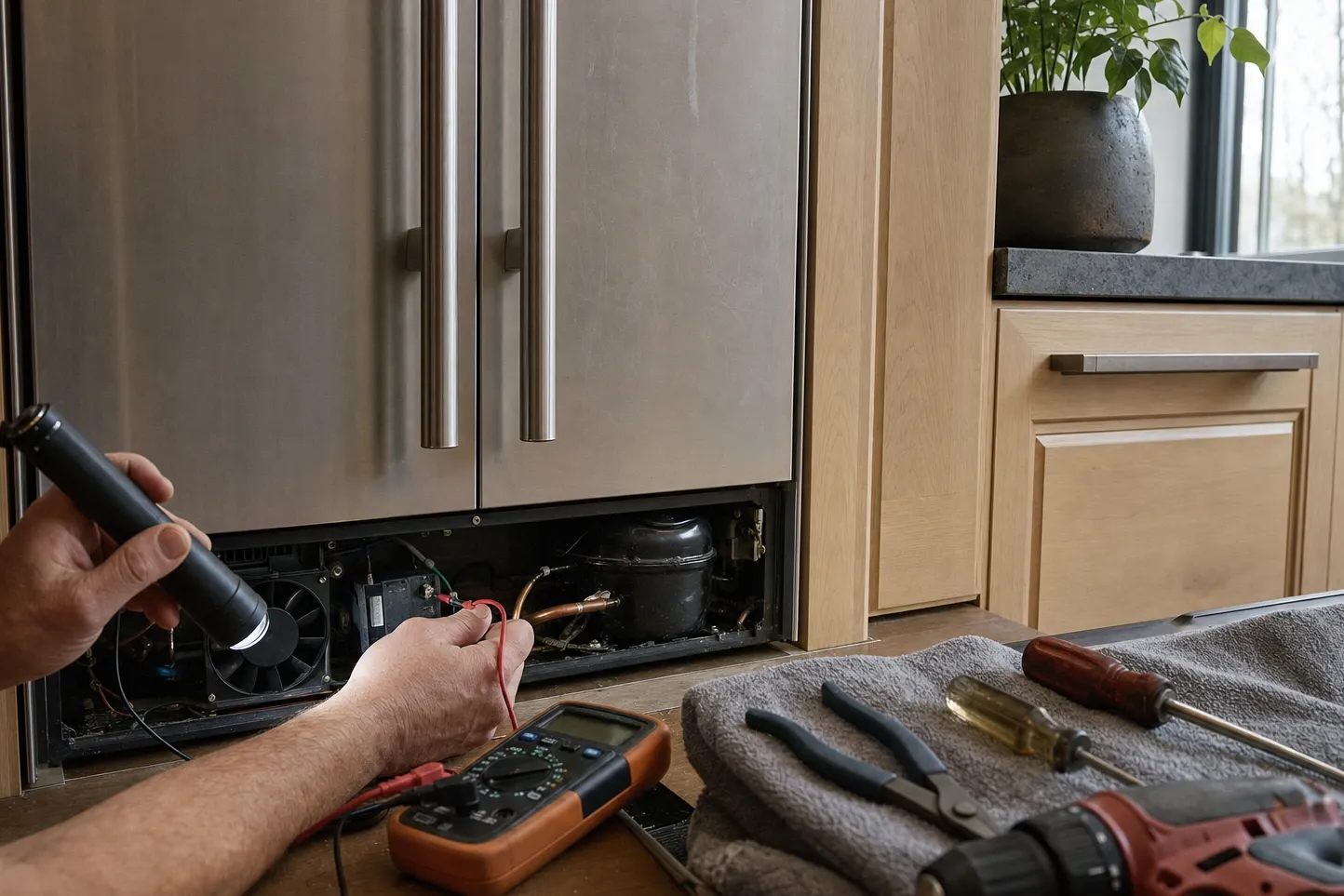
A Sub-Zero built-in that seems to run all day in August worries people more than almost any other symptom, and it is the one most likely to be either trivial or serious with very little in between. The unit is not “working harder because it is hot” in any vague sense. It is running longer because it cannot get rid of the heat it has removed from the cabinet, and there are only a handful of reasons for that.
The useful distinction is between long run times and continuous running. Long run times in a Woodland Hills kitchen at the end of a triple-digit afternoon are normal. Continuous running — where you stand in front of it for a full minute with the doors shut and there is no pause, no cycle, no change in pitch — is a fault, and it is usually cheap to fix while it is still just a fault.
What “running non-stop” actually means
Refrigeration is a heat pump. The evaporator inside the cabinet absorbs heat, the compressor raises the refrigerant’s pressure and temperature, and the condenser coil behind the lower grille dumps that heat into the room. The control only stops the compressor when the cabinet reaches temperature.
So there are exactly two ways to get permanent running. Either the cabinet never reaches temperature, or the control thinks it never does. The first has a physical cause on the heat-rejection side; the second is a sensor or board problem. Both show the same symptom to you standing in the kitchen, which is why guessing is a poor strategy on this equipment.
One number is worth knowing: on the 600 and 700 series, the fresh-food and freezer circuits are independent. If one side holds temperature and the other does not, you have already halved the search space, and you have proved that the half that works is healthy.
Why a Los Angeles kitchen makes it harder
A condenser rejects heat into the room it sits in, and the hotter that room, the smaller the temperature difference it has to work with. A kitchen at 78°F gives the coil plenty of margin. The same kitchen at 95°F in the west San Fernando Valley in August gives it very little, and anything marginal stops being marginal.
Three local conditions do most of the damage:
- Valley heat. Woodland Hills kitchens spend weeks at a time well above what the design assumed. A coil that is 60 per cent blocked coasts through winter and fails visibly in August.
- Hillside dust. The lower grille draws room air across the coil, and hillside houses have more dust in that air. A felted layer across the fins insulates them; it looks like nothing and behaves like a blanket.
- Zero clearance. Panel-ready columns in newer Playa Vista and Westwood kitchens are fitted flush into cabinetry. If the top vent path was blocked during a remodel, the unit is recirculating its own exhaust.
None of that is exotic and none of it is a design flaw. It is why the same model behaves differently four miles apart.
The four faults behind it, in the order we find them
A blocked condenser coil. The most common by a wide margin, and the only one on this list you can address yourself. Dust, pet hair and cooking grease bind into a mat across the fins.
A failing condenser fan. Either the motor is dying, the blade is fouled, or — very commonly on wine and undercounter units — the run capacitor has gone weak. The fan turns slowly or intermittently, so airflow across the coil collapses even though the coil is clean. Often audible as a change in pitch, or a hum with very little air movement at the grille.
A blocked vent path. Cabinetry, a rolled-back kick panel, or a unit pushed back too far. The coil is clean, the fan works, and the hot air is going straight back into the intake.
Low refrigerant charge or a restriction. The sealed system. This is a genuine repair and needs gauges to diagnose honestly. It presents as long run times with a warm cabinet and a condenser that is only warm rather than hot — the reverse of what a blocked coil looks like on touch.
Note where the list starts and where it ends. On this equipment, the sealed system is the last thing a competent diagnosis reaches, not the first.
What to check before calling
Three things, ten minutes, no tools:
- Listen for a cycle. Doors closed, kitchen quiet, one full minute. A unit that pauses is cycling and is probably fine.
- Feel the air at the grille. Put a hand at the lower grille while it is running. You should feel warm air moving out steadily. Warm air that is barely moving points at the fan; no warm air at all points at the fan or the path.
- Look at the coil. Kill the power at the breaker, pull the grille — most clip off without tools — and look. If you cannot see the fins through the dust, vacuum them front-on. Do not use a brush hard enough to bend them, and do not poke anything into the tubing.
Then stand a thermometer in a tumbler of water inside the fresh-food compartment overnight. That gives you a real cabinet temperature instead of a display reading, and it is the single most useful piece of information you can hand a technician on the phone.
When it stops being maintenance
Book a visit when the cabinet is losing ground rather than merely running long: anything above 42°F in the fresh food side, or a freezer sitting in the teens instead of near zero. Book one as well if the coil is clean, the fan is clearly moving air, and it still never pauses — that combination usually means a sensor or the charge, and neither improves on its own.
The $89 call-out buys the journey and the full diagnosis, and it is deducted once you approve the work. What you are paying for at that point is somebody putting readings on it — vent temperatures, fan current, and pressures where the readings point that way — instead of another guess.
Follow-up questions
Is a Sub-Zero supposed to run almost continuously in summer?
Longer run times in a hot month are normal and expected. Genuinely continuous running — no audible pause across an hour with the doors shut — is not, and it means the unit cannot get rid of the heat it is pulling out of the cabinet.
Will vacuuming the condenser coil fix it?
Often, if the coil is the problem. It is the one job on this list a homeowner can safely do: kill the power, pull the lower grille, and vacuum the coil fins from the front without bending them. If run times do not improve within a day, something else is going on.
Can a unit be damaged by running non-stop?
It shortens compressor life and it puts food at risk once the cabinet starts losing ground. It is worth dealing with early, while it is still a fan, a capacitor or a coil rather than a sealed-system repair.