Ice Maker Repair
Sub-Zero Ice Maker Output Dropping: Heat, Hard Water and Scale
A clear-ice maker that has slowed to a handful of cubes is usually telling you about the water or the room, not the compressor. How the harvest cycle works, what slows it, and what to check first.
Written byElena Sandoval
- Role
- Refrigeration technician — cabinet, door and seal work
- In the trade
- 24 years in the trade
- Certification
- EPA 608 certified
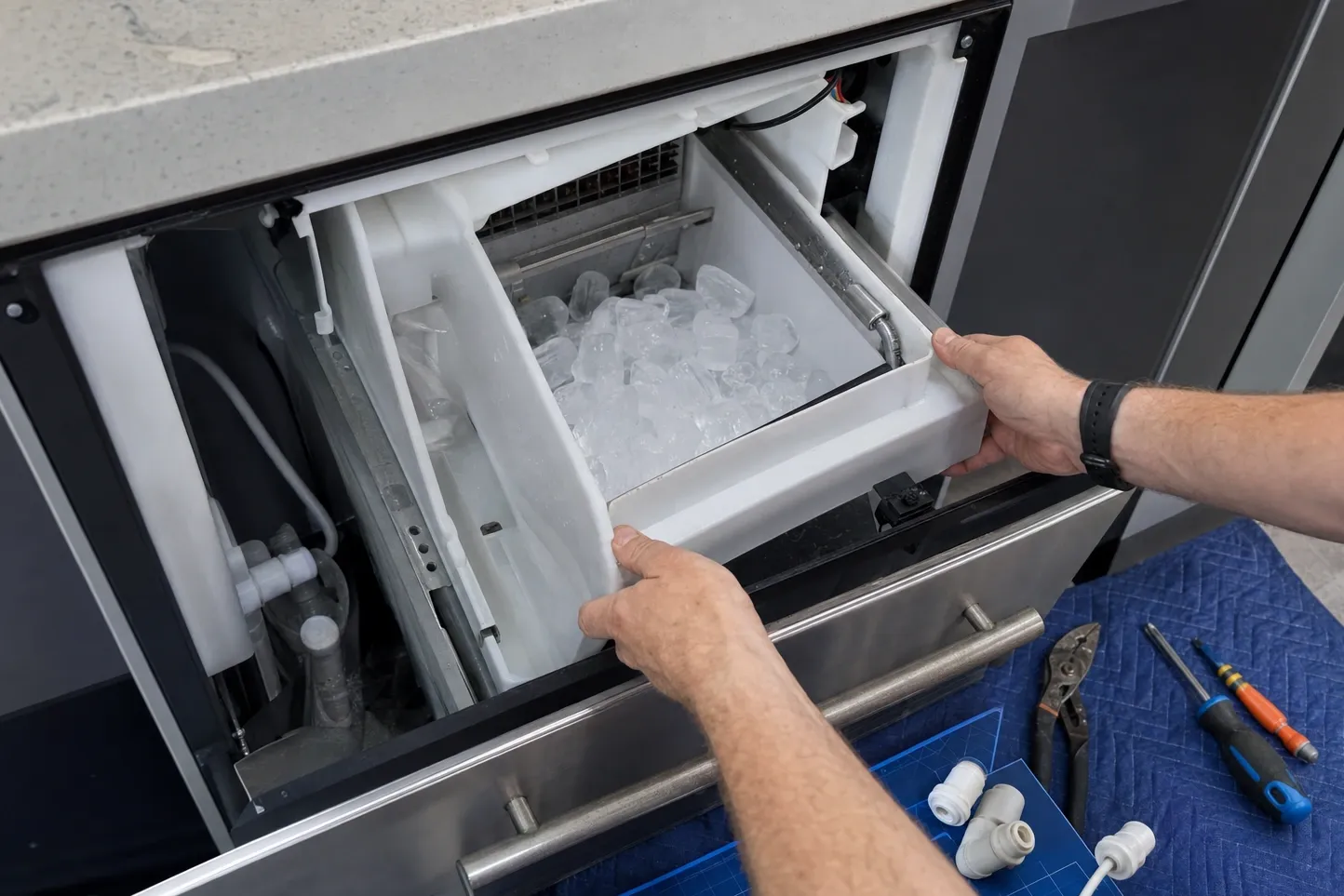
An ice maker that has quietly gone from a full bin to a handful of cubes is one of the most misdiagnosed appliances in a Los Angeles kitchen. The usual conclusion is that the sealed system is going. The usual reality is that something on the water side has changed, or the room around it got hotter, and the machine is doing exactly what it should under conditions it was not given.
This applies to built-in clear-ice makers, undercounter units and the clear-ice modules fitted to refrigerator columns. They share a harvest cycle, and almost everything that slows them down slows them down in the same way.
How a clear cube is actually made
A clear-ice maker does not fill a tray and freeze it. Water is circulated over a chilled mould so that it freezes in thin layers, and the moving water carries dissolved air and minerals away instead of trapping them. That is the whole reason the cube comes out clear and does not crack in a glass — and the reason it takes so much longer than a tray.
Then the mould is warmed briefly so the slab releases, a cutter grid or a harvest mechanism separates it, and the cubes drop into the bin. A bin sensor stops production when it reads full.
Two consequences follow, and they explain most complaints. First, output is inherently slow — a full bin is a day’s work, not an hour’s. Second, anything that interferes with the water circulating over the mould, or with the harvest release, shows up as less ice rather than as no ice. Total failure is actually the easier fault to diagnose.
Heat first, water second
Start with the room, because it is free to check. These units reject heat through a condenser exactly like a refrigerator does, and in a garage conversion, a bar area with no ventilation, or a Woodland Hills kitchen in August, the condenser has very little temperature difference to work with. Output falls away through a hot week and recovers when it cools. That is not a fault.
Then the water. Two things matter and both drift slowly enough that nobody notices:
- Supply pressure and fill. A partly closed valve, a kinked line behind the cabinet or a clogged inlet screen shortens the fill. Short fill makes small, hollow cubes and cuts total output.
- Filter condition. An exhausted filter restricts flow. It is the single most common cause of gradual decline, and the interval on the label assumes water softer than most of this city gets.
If a building has recently flushed its lines — common in newer Playa Vista buildings — grit can reach the inlet screen in one go, and output falls off a cliff rather than drifting. That one is usually a ten-minute clean.
Scale, and why Los Angeles water matters here
Los Angeles water is hard. Hardness is not a taste problem for an ice maker, it is a mechanical one: dissolved calcium and magnesium plate out onto the mould, the cutter grid and the water trough as scale.
Scale does three things at once. It insulates the mould, so freezing takes longer. It roughens the surface, so the slab releases badly and the harvest cycle runs long or stalls. And it holds minerals right where the next batch of water flows, so cubes come out white and crumbly.
The signature is a gradual decline over months with cubes that get progressively cloudier — quite different from a sudden stop. It responds to descaling with the correct nickel-safe cleaner, on the interval the manual gives rather than the one that feels reasonable. It is worth being blunt about this: in this city, descaling is not optional maintenance on these machines, and most of the tired ice makers we are called to have simply never had it done.
What to check in ten minutes
- Is the bin sensor being fooled? Empty the bin completely and see whether production restarts. A sensor reading full over an empty bin is a common and inexpensive fault.
- Is the arm or switch in the run position? Sounds obvious. It gets knocked during cleaning more often than anyone admits.
- Look at the water line. Trace it to the shut-off valve. Fully open? Kinked behind the unit after somebody pushed it back? Note the filter’s age.
- Look at the mould and grid. White, chalky deposits mean scale. Clean with the correct product — never vinegar or a household descaler, which will attack the plating.
- Feel the grille. Warm air moving steadily means the condenser side is working. Barely-moving air means the fan or the coil, and the ice is a symptom.
Give it two full harvest cycles after any change before judging the result. Nothing on this machine responds in ten minutes.
When it is the module or the sealed system
Book a visit when the bin stays dry with the arm down and the water supply proven, when water pools under the unit or freezes into a slab in the bottom of the cabinet, or when the harvest stalls half-released with a slab stuck to the mould. Those point at the harvest solenoid, the water valve, the drain pump or the sealed system, and all four want gauges, a meter and parts rather than a clean.
The $89 service call covers the trip and the diagnosis and is credited against the repair. On an ice maker that is money well spent early: a machine that has been limping for a year with scale on the mould and a stalling harvest is a much longer job than the same machine caught in month two.
Follow-up questions
How much ice should a built-in clear-ice maker actually make in a day?
Far less than a freezer's tray-type maker, and that is by design — a clear cube is frozen slowly in layers so air and minerals are pushed out. A hot room, a warm water supply and an exhausted filter all cut that further. Judge it against what the unit did last winter, not against a bag from the store.
Why are the cubes cloudy or hollow now when they used to be clear?
Cloudy or hollow cubes are a water-side symptom: not enough water reaching the mould, or too many dissolved minerals in what does. Filter, inlet screen and fill level come first. A hollow cube that collapses in a glass usually means the fill is short.
Is a smell in the bin a fault?
Usually it is the bin and the drain rather than the machine. Ice absorbs odours, and a drain that is slow leaves standing water. Empty it, wash the bin, clear the drain, and give it two full harvests before judging the result.